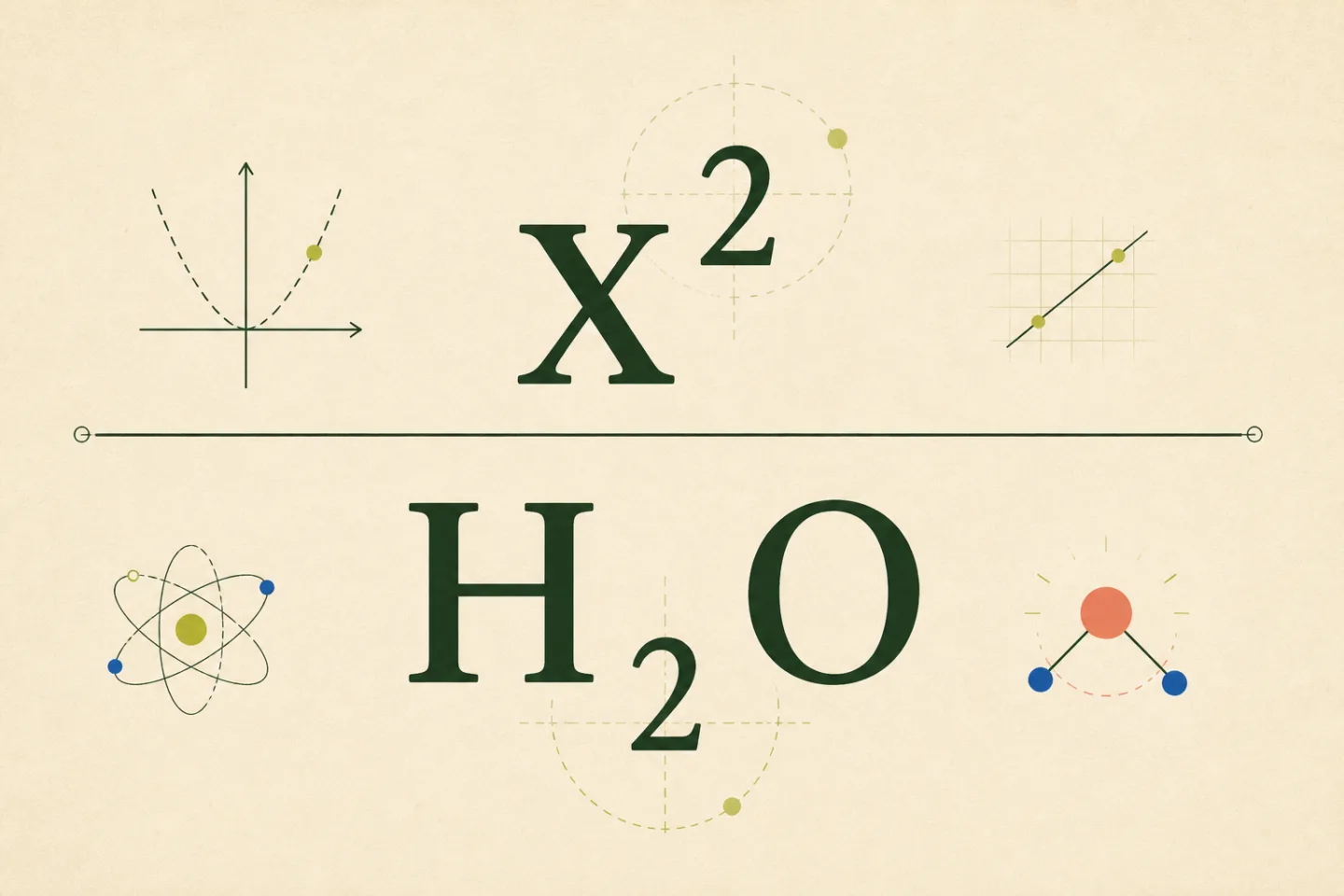
Use superscript for exponents, powers, footnote marks, and ordinal endings. Use subscript for chemical formulas, sequence indexes, and labels that belong below the baseline.
One digit, two floors, two jobs. Upstairs, a number often tells you about a power. Downstairs, it often counts or labels something. The baseline is not decoration. It is part of the message.
The 2 sits above the baseline.
The 2 sits below the baseline.
The same number can tell two different stories
A raised 2 after x means “x multiplied by itself.” A lowered 2 after H means “two hydrogen atoms.” The character is not decoration. Its position carries information.
| Example | Position | What it communicates |
|---|---|---|
| x² | Superscript | x raised to the second power |
| 10⁻³ | Superscript | Ten raised to a negative power |
| 1ˢᵗ | Superscript | An ordinal ending |
| H₂O | Subscript | Two hydrogen atoms in water |
| a₁, a₂, a₃ | Subscript | Items in an indexed sequence |
Choose by meaning, not by appearance
Math and scientific notation
Exponents belong above the line. In 6.02 × 10²³, only 23 is raised. The coefficient 6.02 and the base 10 stay at normal size; 23 is the power of ten.
See more superscript number examples →Chemistry and indexes
Atom counts and item indexes belong below the line. H₂O, CO₂, and x₁ all use subscript, but for different reasons.
Open the Subscript Generator →Three mistakes worth catching
H²O is not H₂O
The first version raises the 2 and suggests an exponent. It makes water look like it wandered into an algebra problem. The chemical formula for water uses a lowered 2.
Do not raise the whole scientific number
6.02 × 10²³ is the readable plain-text form. Turning 6.02 into tiny raised characters makes it look as though the complete value is an exponent.
Do not replace missing Latin letters with lookalikes
Unicode has no standard Latin subscript b or c. That is why Tiny text converts abc123 to ₐbc₁₂₃. The b and c stay at normal size. Using Greek beta or a superscript c would change the characters, not merely their position.
Plain-text Unicode or editor formatting?
Use Unicode when the destination accepts plain text and you need the position to survive a copy and paste. Use a word processor or equation editor for formal work, long equations, or content that must be edited and read accessibly.
The main subscript and superscript generator handles both positions. Choose Formulas & numbers for conventional notation. Choose Tiny text only when you intentionally want each available character shifted.
A ten-second check before you copy
Read the expression aloud. If the small number means “to the power of,” it probably belongs above. If it counts atoms or identifies an item in a sequence, it probably belongs below. Then look at the preview once. That short pause catches most position mistakes.